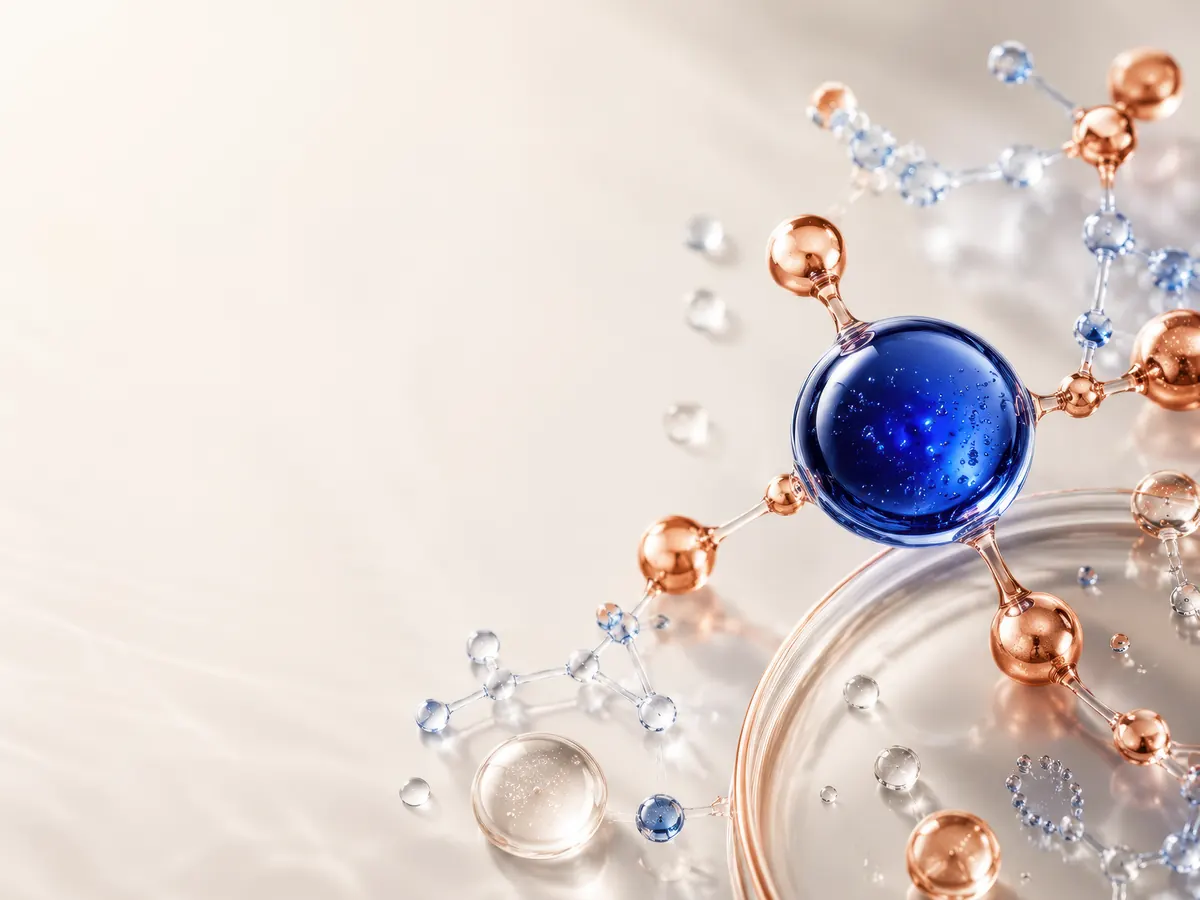
The serum is blue. Not aqua, not tinted, not dyed. A specific, mineral, almost-electric blue that looks like nothing else in skincare. People ask about it constantly: what is it, why is it blue, is the color the product.
The short answer is yes. The blue is the active.
The longer answer requires going back to a liver-cell experiment in 1973, a tripeptide isolated from human plasma, and roughly five decades of published research on what happens when you bind three amino acids to a single ion of copper.
This is what a copper peptide is. This is what GHK-Cu does. And this is the honest version, with the citations.
01 — What it actually is
GHK-Cu is the standard shorthand for the copper(II) complex of the tripeptide glycyl-L-histidyl-L-lysine. On a cosmetic ingredient list, it appears as Copper Tripeptide-1.
The structure is small — three amino acids and a single copper ion, with a molecular weight of about 403.9 daltons.1 It is one of the smallest biologically active peptides known, and one of the few cosmetic actives that occurs naturally in the human body.
GHK is present in human plasma, saliva, and urine. In the body, it binds copper with high affinity, and most of the time it exists as the GHK-Cu complex rather than as free peptide.2
This matters for the blue. The color is the copper. Once GHK binds Cu²⁺, the complex absorbs light in the orange end of the spectrum and reflects blue. No dye is involved. A copper-peptide serum that arrives clear is either using a very low concentration of GHK-Cu or has bound the copper in a way that masks the color. A vivid, saturated blue is a rough visual signal that the peptide is present at a meaningful concentration.
02 — Where it came from
In the early 1970s, a biochemist named Loren Pickart was studying liver tissue. He noticed that liver cells from older donors, when cultured in plasma from younger donors, began behaving like younger tissue — synthesizing proteins at rates characteristic of cells decades younger than they were.3
Something in young plasma was resetting old cells.
By 1973, Pickart had isolated the active fraction from human serum albumin and identified it as a tripeptide: glycine, histidine, lysine. By 1977, the structure was confirmed. By 1980, he had proposed that the peptide's biological activity depended on its affinity for copper — that GHK was not really the active, the GHK-Cu complex was.3
The peptide spent the next forty-six years generating one of the most varied research records in regenerative biology: wound healing, skin remodeling, hair follicle signaling, lung repair, neuroprotection. Pickart died in 2023. The literature he started is still expanding.
Two facts from that literature do most of the work in understanding copper peptide skincare:
GHK levels in human plasma fall from approximately 200 ng/mL at age 20 to roughly 80 ng/mL by age 60.
That is a decline of about 60% across adult life, and it tracks the decline in the body's ability to remodel its own tissues.24
The premise of topical copper peptide skincare is straightforward: if GHK-Cu is a repair signal the body makes less of as it ages, applying it to the skin restores some fraction of that signal locally.
03 — What GHK-Cu does in skin
The published research describes GHK-Cu acting in several directions at once. Three of them matter most for skincare.
Collagen and the dermal matrix
The first major study on GHK-Cu in skin biology was published in FEBS Letters in 1988 by Maquart, Pickart, and colleagues, showing that the GHK-Cu complex stimulated collagen synthesis in cultured human fibroblasts.5 That finding has been replicated across decades of cell-culture work showing GHK-Cu upregulating type I and type III collagen, elastin, glycosaminoglycans, and decorin — the structural and water-binding components of the dermis.2
In a 12-week clinical study referenced in the Pickart & Margolina 2018 review, a GHK-Cu cream applied to the thigh produced an increase in collagen production in 70% of women treated, compared with 50% treated with vitamin C cream and 40% treated with retinoic acid.2
That figure is worth holding lightly — it is one study, on one body site, with limited sample size — but it is the kind of comparative result that explains why GHK-Cu has stayed in the literature for forty years rather than fading like most cosmetic actives do.
MMP / TIMP balance
A second mechanism is regulatory. Skin contains matrix metalloproteinases (MMPs) — enzymes that break down collagen and elastin — and their natural inhibitors (TIMPs). With age, UV exposure, and inflammation, MMP activity rises and TIMP activity falls, and the dermal matrix loses ground faster than it can rebuild.
A randomized, double-blind clinical study by Badenhorst and colleagues, published in the Journal of Aging Science, found that GHK-Cu modulates MMP and TIMP expression and improves facial wrinkle parameters, with over 30% improvement in wrinkles at 8 weeks compared with both a Matrixyl 3000-based peptide complex and a control serum.6
This is the part of GHK-Cu's mechanism that does not get talked about enough. It is not only building new matrix. It is slowing the breakdown of existing matrix.
Antioxidant and anti-inflammatory signaling
GHK-Cu has been shown in vitro and in vivo to scavenge reactive oxygen species, modulate antioxidant gene expression (including upregulation of multiple antioxidant pathways), and exert anti-inflammatory effects on damaged tissue.27 This is the part of the literature that produced the broader "regenerative peptide" framing — the same signaling appears in wound healing, lung research, and gastrointestinal repair studies, not just skin.
A large-scale gene expression analysis, conducted using the Broad Institute's Connectivity Map, reported that GHK-Cu shifts the activity of approximately 31% of human genes toward a healthier expression pattern — over 4,000 genes total, including DNA repair, antioxidant, and proteasome-related pathways.2
That number circulates a lot online, often without context. The context is: this is a transcriptomic database analysis, not a clinical outcome. It tells us that GHK-Cu touches many pathways, not that applying a serum will modify your genome. The skin-level effects above are what topical formulation can reasonably claim.
04 — What "copper peptide skincare" actually means
Three things separate a serious copper peptide formulation from a marketing exercise.
1. Concentration disclosure.
Most published clinical work on topical GHK-Cu uses concentrations in the range of 0.1% to several percent depending on the carrier system. The relevant number for a buyer is what is on the back of the carton. If a brand calls itself "copper peptide" but does not state the GHK-Cu percentage, the formulation is doing less work than the label.
2. The blue is the proof.
Because the color comes from the copper itself, color intensity is a rough visual indicator of how much GHK-Cu is in the bottle. A faint blue serum at the same retail price as a vivid blue serum is — all else equal — a lower-concentration formula.
3. Compatibility with the rest of the routine.
Copper peptides have historically been described as incompatible with high-dose direct vitamin C (L-ascorbic acid) because the copper ion can interact with ascorbate. The practical workaround is to use them at different times of day. They pair without issue with retinoids, niacinamide, hyaluronic acid, and peptide stacks built around them.
05 — Where the comparison to other actives lands
A few honest framings.
GHK-Cu vs. retinoids.
Retinoids have the deepest clinical record of any topical anti-aging active, and they work by a completely different mechanism — accelerating cell turnover and upregulating collagen synthesis through retinoic acid receptor signaling. They are also frequently irritating, often photosensitizing, and disqualified during pregnancy. GHK-Cu has a benign tolerance profile, no photosensitization concern, and can be used in combination with retinoids by applying the peptide first and letting it settle. They are not substitutes for each other. They are complementary.
GHK-Cu vs. vitamin C.
Vitamin C is an antioxidant and a cofactor in collagen synthesis. GHK-Cu signals fibroblasts to make more collagen and modulates the enzymes that break it down. The mechanisms are different. The 12-week comparative study referenced above suggested GHK-Cu produced collagen improvements in more participants than either vitamin C or retinoic acid creams in that protocol — a result that has not been replicated at scale, but is worth noting.2
GHK-Cu vs. other peptides.
Most cosmetic peptides are signal peptides (telling fibroblasts to produce matrix) or neuropeptides (interfering with muscle-contraction signaling — Argireline, SNAP-8, Leuphasyl). GHK-Cu is unusual: it is a signal peptide and a carrier peptide. The carrier function — ferrying copper into cells — is part of how it works. No other widely used cosmetic peptide does both.
06 — The Selfore position
We hold GHK-Cu at 1% in Whisper. That is the upper bound of concentrations typically used in published cosmetic research, and high enough that the copper itself produces the serum's color. No dye is added. The blue is the peptide.
We pair it with an 11% neuropeptide system — Argireline at 8%, SNAP-8 at 1.5%, Leuphasyl at 1.5% — so the formula addresses two different pieces of how skin shows time: the look of expression lines from movement (neuropeptide work) and the look of bounce and resilience from matrix support (copper peptide and Matrixyl 3000 work). The serum is fragrance-free, dye-free, alcohol-free, and silicone-free. Quiet support for high-active care.
Argireline vs. Botox: what a peptide can and can't do
07 — Frequently asked
Why is my copper peptide serum blue?
Because GHK-Cu is blue. The copper ion bound to the peptide absorbs orange wavelengths and reflects blue. The intensity of the color tracks roughly with the concentration of the peptide in the bottle. No dye is needed.
Can I use copper peptides every day?
Yes. The published research uses twice-daily application protocols, and GHK-Cu has a long, well-documented tolerance profile across decades of clinical and consumer use.
Can I use copper peptides with retinol?
Yes. Apply the peptide serum first, press it in, let it settle for about sixty seconds, then layer the retinoid.
Can I use copper peptides with vitamin C?
Not at the same time of day. Keep direct L-ascorbic acid to one part of the day (often morning) and copper peptides to the other (often evening). They do not need to be in the same step.
Is GHK-Cu the same as copper tripeptide-1?
Yes. Copper tripeptide-1 is the INCI (cosmetic ingredient list) name. GHK-Cu is the research literature shorthand. Same molecule.
Will copper peptides do what retinoids do?
No. They work differently. Copper peptides signal fibroblasts and modulate matrix turnover; retinoids drive cell turnover and receptor-level gene expression. Many people use both. They are not substitutes.
Are copper peptides safe in pregnancy?
GHK-Cu is a naturally occurring human peptide and has no contraindication on the published record specific to pregnancy. As with any cosmetic active, review the full ingredient list with a physician.
References
Selfore · Journal · Peptide Science · N°02
Published — Edition N°01 · Last reviewed — Edition N°01
This article is for general education. It is not medical advice. Consult a board-certified dermatologist for guidance on any clinical concern.
Footnotes
Copper peptide GHK-Cu. Structure, molecular weight, and natural occurrence in human plasma. See also: Wikipedia, Copper peptide GHK-Cu, summarizing primary literature dating to Pickart's 1973 isolation. ↩
Pickart, L., & Margolina, A. (2018). Regenerative and protective actions of the GHK-Cu peptide in the light of the new gene data. International Journal of Molecular Sciences, 19(7), 1987. https://doi.org/10.3390/ijms19071987 (PMC6073405) ↩ ↩2 ↩3 ↩4 ↩5 ↩6 ↩7
Pickart, L. (1973). Isolation of a tripeptide growth factor from human plasma albumin. Ph.D. dissertation, University of California, San Francisco. See also: Pickart, L., Freedman, J. H., Loker, W. J., et al. (1980). Growth-modulating plasma tripeptide may function by facilitating copper uptake into cells. Nature, 288, 715 – 717. ↩ ↩2
Pickart, L., Vasquez-Soltero, J. M., & Margolina, A. (2015). GHK peptide as a natural modulator of multiple cellular pathways in skin regeneration. BioMed Research International, 2015, 648108. https://doi.org/10.1155/2015/648108 (PMC4508379) ↩
Maquart, F. X., Pickart, L., Laurent, M., Gillery, P., Monboisse, J. C., & Borel, J. P. (1988). Stimulation of collagen synthesis in fibroblast cultures by the tripeptide–copper complex glycyl-L-histidyl-L-lysine-Cu²⁺. FEBS Letters, 238(2), 343 – 346. ↩
Badenhorst, T., Svirskis, D., & Merrilees, M. (2016). Effects of GHK-Cu on MMP and TIMP expression, collagen and elastin production, and facial wrinkle parameters. Journal of Aging Science, 4(3). ↩
Pickart, L., Vasquez-Soltero, J. M., & Margolina, A. (2012). The human tripeptide GHK-Cu in prevention of oxidative stress and degenerative conditions of aging: implications for cognitive health. Oxidative Medicine and Cellular Longevity, 2012, 324832. ↩